Mike Malone:
The Lawman
Michael “Mike” Francis Malone was born in 1893 in Jersey City, NJ, one of five siblings. Their early life was marked by hardship; their mother died in 1905, and their alcoholic, philandering father abandoned them two years later.
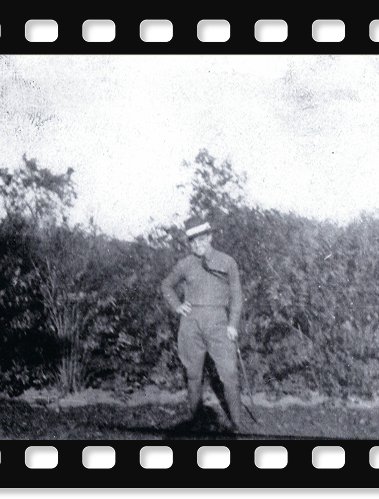
Despite a difficult start, Mike was driven. After graduating high school in 1911, he joined the Army’s elite Flying Cadet Squadron in 1913. He served honorably in World War I from April 1917 until the armistice on November 11, 1918, returning to the United States around Christmas of that year.
Just days after his return, on December 26, 1918, Mike married his wife, Irene. In 1919, he joined the Bureau of Investigation (which would later become the FBI in 1935). However, tragedy struck when their infant son, James, died in March 1920. Mike left the Bureau and joined the Treasury Department’s Intelligence Unit (IU), the precursor to the IRS-Criminal Investigation division. He would remain with the IU until his death in 1960.
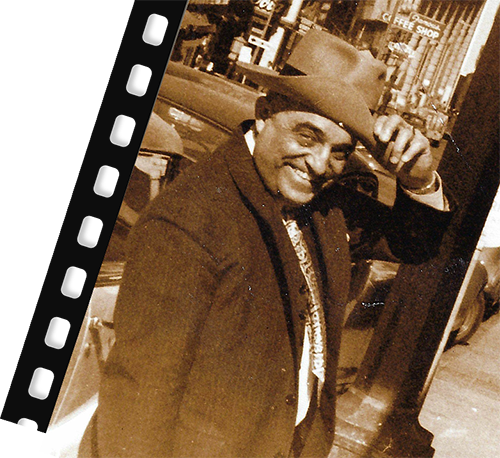
The IU’s primary mission was to catch tax evaders. With Prohibition enacted in 1920, the unit became the key enforcement arm against the flood of illegal cash. From 1920 to 1927, Mike was instrumental in exposing corruption, bringing down hundreds of crooked Prohibition agents and playing a role in the Teapot Dome scandal that reached the highest levels of the Harding administration.
Personal tragedy struck again in 1927 when his daughter, Mary, was killed by a bus. That same year, a Supreme Court decision established that all income, legal or illegal, was taxable, providing the IU with a powerful new weapon against organized crime.
Al Capone:
THE GANGSTER
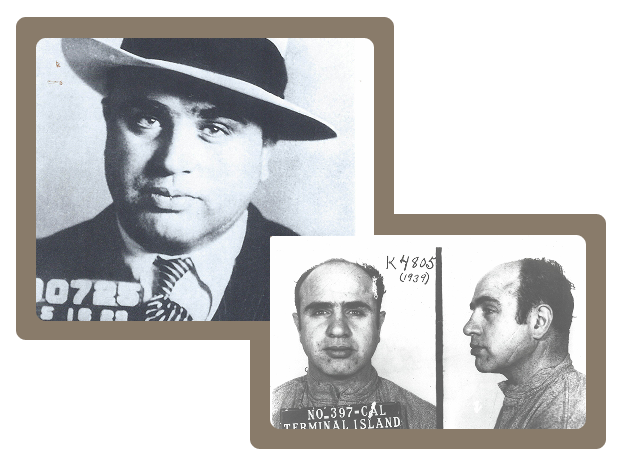
Alphonse Capone was born in Brooklyn, NY, in 1899 to Italian immigrant parents. Prone to violence, he dropped out of school in the sixth grade and fell in with street gangs. On December 30, 1918—just four days after Mike Malone’s wedding—Capone married Mae Coughlin.
In 1919, he moved to Chicago to join forces with crime boss Johnnie Torrio. By 1920, after orchestrating the murder of a rival, Torrio and Capone controlled the city’s South Side. Capone, a brilliant and ruthless businessman, managed a vast criminal enterprise, bribing city officials and amassing a fortune estimated at $100 million a year.
Violence was his primary tool. When President Herbert Hoover took office in 1929, he was determined to end Capone’s reign of terror, particularly after the infamous St. Valentine’s Day Massacre. A group of wealthy Chicago citizens, known as the “Secret Six,” secretly funded the government’s efforts to bring him down.
A Collision Course
Hoover gave the order to Elmer Irey, the chief of the IU: “Get Capone.”
The IU decided to test the new tax evasion law on Capone’s top lieutenants first. When that proved successful, Irey sent his best agent, Mike Malone, to Chicago.
From late 1928 to early 1930, Malone undertook an unprecedented assignment: he went to “gangster school” under the tutelage of a rival mobster to learn how to infiltrate Capone’s world. In March 1930, using the alias Michael Lepito, he checked into the Lexington Hotel—Capone’s headquarters.
For the next year and a half, Mike Malone lived inside the belly of the beast. He gained Capone’s trust, becoming an insider in his organization while secretly gathering evidence of the gangster’s untaxed income. He fed this crucial information back to his superiors, building the case that would finally bring down America’s Public Enemy #1.
By early 1931, armed with Malone’s evidence, the government had enough to indict Capone’s top men, sending many to prison. In June 1931, Capone, believing he could secure a light sentence, struck a plea deal. However, the judge rejected it, and a trial was set for October.
The prosecution methodically presented its case, built on the intelligence Malone had risked his life to gather. Capone’s defense was weak, and on October 17, 1931, he was found guilty of tax evasion and sentenced to 11 years in federal prison. The agent had taken down the gangster.